

Think about the last time you checked your phone’s screen time report and felt a mild wave of guilt. Between bouncing from demanding Slack channels to late-night financial spreadsheets, your brain constantly runs on high alert. If you are feeling perpetually exhausted but struggling to sleep, you are experiencing standard cognitive fatigue.
- 1. The 20-Minute Cortisol Reset
- 2. Upgrading Focus via Attention Restoration
- 3. Lowering Rumination and Negative Thought Loops
- 4. Harnessing Phytoncides for Systemic Well-Being
- 5. Breaking Screen Addiction Through Sensory Engagement
- 6. Stabilizing Sleep Architecture via Natural Light
- Action Plan: Treat Green Time Like an Asset Class
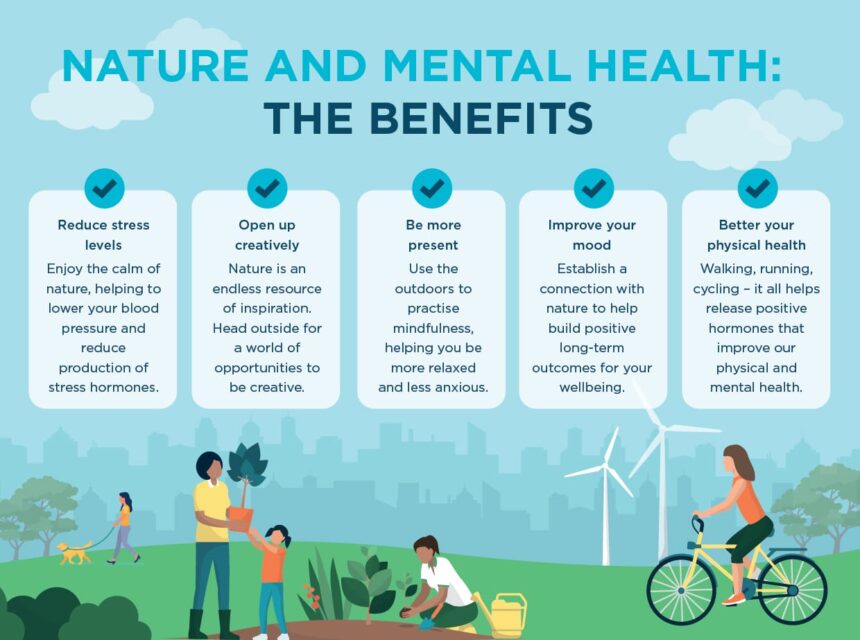
Here are six data-driven reasons why stepping away from your desk and investing in nature therapy can fundamentally upgrade your mental health, stress relief, and overall well-being.
1. The 20-Minute Cortisol Reset
You don’t need to quit your corporate job and move to a remote mountain to see tangible mental health returns. Research shows that as little as 20 to 30 minutes of sitting or walking in an outdoor space significantly drops your levels of cortisol, the primary hormone associated with your body’s stress response.
Think of cortisol like a high interest rate on a loan; a brief spike helps you handle an immediate emergency, but a chronically high rate destroys your long-term financial health. When you step into a green space, your sympathetic nervous system (your “fight-or-flight” engine) slows down, allowing your parasympathetic nervous system (the “rest-and-digest” mechanism) to take over. It’s a rapid, biological decompression that unburdens your mind.
2. Upgrading Focus via Attention Restoration
Your daily work demands constant, high-level “directed attention,” the exhausting mental energy required to ignore distractions, read complex data, and make tough decisions. Over the course of an eight-hour workday, this mental battery completely drains.
Nature operates on what environmental psychologists call “soft fascination.” The movement of wind through leaves, the patterns of clouds, or the ripple of water captures your attention automatically without requiring active conscious effort. This shift gives your prefrontal cortex, the analytical engine of your brain, a chance to rest and rebuild. Data suggests that spending time in a natural environment can boost your working memory and performance on problem-solving tasks by up to 40%.
3. Lowering Rumination and Negative Thought Loops
When you are stressed about professional goals or personal milestones, your mind can easily slip into rumination. This is the exhausting habit of playing your mistakes and anxieties on a continuous loop. Neurologically, this occurs in an area of the brain known as the subgenual prefrontal cortex.
A landmark Stanford University study tracked participants who took a 90-minute walk through either a loud urban setting or a quiet, tree-lined green space. The urban walkers showed no mental shifts, but the outdoor walkers showed a massive decrease in neural activity within that rumination center. They didn’t just feel better; their brains actively stopped spinning the negative loops that fuel anxiety and depression.
4. Harnessing Phytoncides for Systemic Well-Being
The benefits of a walk in the woods aren’t just psychological; they are biochemical. Trees and plants emit airborne chemical compounds called phytoncides, which act as their natural defense mechanism against insects and rot.
5. Breaking Screen Addiction Through Sensory Engagement
Most digital tools are deliberately engineered to hijack your dopamine pathways, leaving you hooked on endless notification loops. This constant state of partial attention fractures your focus and heightens baseline anxiety.
Getting outside serves as a natural digital detox. Out on a trail, your sensory landscape expands beyond a flat, glowing rectangle. You are forced to engage your peripheral vision, track dynamic depth, and listen to multi-layered, real-world sounds. This immersive sensory engagement resets your overstimulated dopamine receptors, breaking the compulsive urge to check your phone every four minutes.
6. Stabilizing Sleep Architecture via Natural Light
Your mental well-being depends entirely on your sleep quality. If you spend your morning under flickering office fluorescent bulbs and your evening staring at blue-light-emitting devices, you completely scramble your circadian rhythm, the internal biological clock regulating your sleep-wake cycle.
Early morning exposure to natural sunlight stops the production of melatonin (the sleep hormone) and triggers a healthy morning surge of cortisol. This natural anchor ensures that when darkness falls later, your body releases melatonin right on schedule. Better sleep architecture translates directly to greater emotional resilience, sharper critical thinking, and a much higher tolerance for workplace frustration.
Action Plan: Treat Green Time Like an Asset Class
| Strategy | Time Commitment | Core Mental Benefit |
|---|---|---|
| The Daily Micro-Break | 10 Minutes | Lowers acute stress and resets immediate focus |
| The Nature Pyramid | 2-3 Hours / Week | Rebuilds cognitive endurance and stops rumination |
| The Off-Grid Reboot | 1 Weekend / Quarter | Deeply resets circadian rhythm and burns out digital fatigue |
To get the highest return on investment from nature therapy, stop treating it as an optional luxury or a lazy Sunday afternoon indulgence. Treat it like a vital asset class in your personal health portfolio. You don’t need to overcomplicate the logistics: step outside without your headphones, find a park, a trail, or a quiet green space, and simply walk for twenty minutes. Your brain will handle the rest.