
You are sitting in a morning strategy meeting, trying to look at a dense spreadsheet on your phone while typing a quick message to a client, wishing your pocket didn’t feel like it was holding a brick. For years, tech companies have promised that a single device could solve this exact multitasking nightmare by folding a tablet into your pocket. Yet every time you check the price tag, your inner financial planner winces.
We have officially moved past the experimental phase of flexible screens. What used to be a fragile, ultra-luxury novelty has evolved into a fiercely competitive product category. With global shipments projected to surge 20% this year alone, major players like Samsung, Motorola, and Google are aggressively iterating, while rumors of Apple’s impending entry are forcing the entire industry to grow up fast. But as smart consumers managing tight budgets, we have to look past the marketing glare and ask the hard financial question: are foldable phones actually worth your hard-earned money yet?
Let’s break down the raw mathematics of the foldable market to see if the technology and the economics finally align for your wallet.
1. The Capital Investment remains Eye-Watering
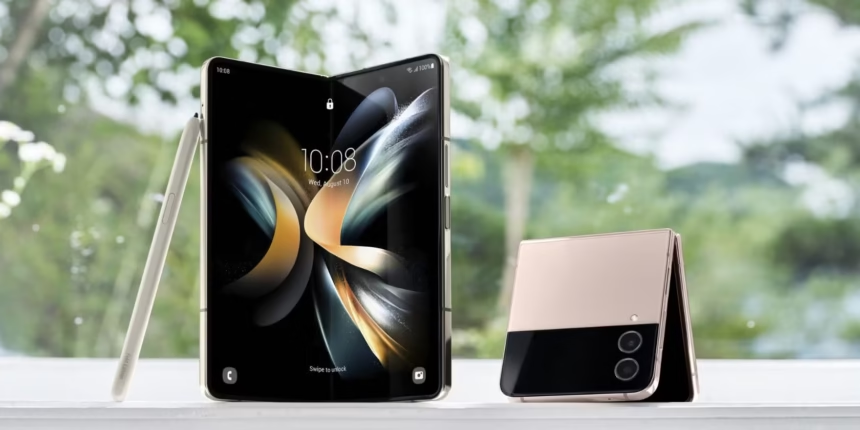
Let’s start with the most obvious barrier: the entry price. Buying a top-tier book-style foldable is not a casual upgrade; it is a major capital allocation. A flagship smartphone review of the latest tech shows that the benchmark Samsung Galaxy Z Fold 7 and the Google Pixel 10 Pro Fold still hover between $1,700 and $1,900.
To put that in perspective, that is the cost of a high-end business laptop plus a standard flagship phone combined. While prices have technically stabilized, book-style foldables remain stubbornly positioned as ultra-premium luxury goods rather than mass-market options.
2. Clamshells Offer a Better Financial Compromise
If you love the nostalgia and compact nature of a folding device but refuse to drop two grand, the “clamshell” or flip-style segment is where the real price discovery is happening. Devices like the Motorola Razr Ultra and the Samsung Galaxy Z Flip 7 sit around the $1,000 mark and some entry-level flip models are dropping to $700.
From a purely financial perspective, these are much easier to swallow because they cost roughly the same as a standard glass slab phone. However, remember what you are paying for here: you aren’t getting a giant productivity canvas; you are mostly paying for a standard-sized screen that takes up less physical real estate in your pocket.
3. The Depreciation Curve is Aggressive
As a finance professional, you know that residual value matters. Traditional flagships, particularly iPhones, hold their value remarkably well, depreciating by roughly 40% to 50% in their first year. Foldables, historically, are a financial bloodbath on the secondary market.
Industry data indicates that many Android foldables experience a staggering 60% drop in trade-in and resale value within just six months of launch. The complex moving parts and perceived wear-and-tear mean that the secondhand market is deeply skeptical of used foldables, so if you plan to upgrade again in two years, get ready to absorb a massive capital loss.
4. Durability Outpaces the Cost of Insurance
In the early days, a single grain of sand could instantly destroy a $2,000 screen. Today, engineering has vastly improved. Most 2026 models feature titanium-reinforced hinges and improved IP48 water and particle resistance ratings, certified to withstand over 200,000 folds which translates to roughly five years of heavy daily use.
The underlying problem is that if something does go wrong out of warranty, the repair costs are ruinous. Replacing an inner flexible screen can easily cost upwards of $500. Unless you are willing to pay for premium device insurance every month, you are carrying a high-risk financial liability in your pocket.
5. The Productivity Return on Investment (ROI)
For the 25–45 demographic, time is quite literally money. This is where the book-style foldable builds its strongest investment case. If your daily workflow involves reviewing PDF legal contracts, tracking complex financial charts, or managing split-screen communications on the go, the 7.6 to 8-inch inner display offers genuine utility.
Pilot enterprise programs tracking corporate deployments have noted productivity gains of up to 22% for mobile workers using multi-window folding layouts. If a phone genuinely prevents you from needing to boot up your laptop at a coffee shop or airport gate, it stops being a toy and starts operating as a revenue-generating tool.
6. The Battery and Camera Tax
When you buy a foldable, you are paying more money for hardware specs that are often inferior to cheaper, traditional phones. Because folding hinges consume massive physical space inside the chassis, battery capacities suffer.
Most book-style foldables carry smaller split batteries that struggle to deliver more than five to six hours of heavy screen-on time. Furthermore, the periscope zoom lenses and massive camera sensors found in standard flagships simply cannot fit into a ultra-thin folding half. If world-class photography or two-day battery life are your top priorities, you will be paying a premium for a subpar experience.
The verdict comes down to your personal balance sheet and how you define utility. Foldable phones are no longer a high-risk gamble, but they are still a luxury tax on convenience. If you are a mobile-first professional whose income is tied to fast, multi-window workflows, the efficiency gains of a book-style device can justify the steep price tag. For everyone else, standard smartphones still offer far better longevity, better cameras, and superior asset retention per dollar spent.
Your next move: Take an honest look at your screen-time metrics this week; if you spend more than two hours a day editing documents or spreadsheets on your phone, go test a book-style foldable in person otherwise, keep your wallet closed and let the market prices fall for another year.